
Direct talks between the US and Iran, mediated by Pakistan, have failed to produce an agreement after 21 hours of negotiations, with disagreements over Iran's nuclear ambitions and sanctions proving insurmountable.

A new study reveals that AI chatbots often provide inaccurate and incomplete medical information, raising concerns about their use in healthcare communication.

The Vivo V70 FE will hit the Indian market probably in early April. It is expected to feature a 200 MP main rear camera with OIS and slim screen borders.

Prime Minister Narendra Modi launched a strong attack on the Mamata Banerjee government in West Bengal, accusing it of facilitating cultural changes through infiltration, presiding over a 'Maha jungleraj' in tribal areas, and betraying women, farmers, and youths.

Iran blames the US for 'maximalism' and 'shifting goalposts' leading to the collapse of the Islamabad talks.

The clock on the ceasefire is running out. But everyone's already whispering about round two, possibly as soon as this weekend.

Robin Liu steps down as India CEO of OnePlus. The company shares key updates on its India operations and future strategy. Here's what it means for the brand and market.

IT major Wipro reported a consolidated net profit of Rs 3,501.8 crore for March quarter FY26, a 1.89 per cent decrease from the previous year, amidst a challenging macroeconomic environment. The company also announced a mega Rs 15,000 crore share repurchase programme.

ICC CEO Sanjog Gupta discusses the globalisation of cricket, highlighting India's crucial role and the impressive performances of Associate nations in the T20 World Cup.

Benchmark stock indices Sensex and Nifty dived sharply by nearly 2 per cent on Sunday after Finance Minister Nirmala Sitharaman proposed a hike in the Securities Transaction Tax (STT) on derivatives. Reversing the early gains, the 30-share BSE Sensex plunged sharply by 2,370.36 points or 2.88 per cent to slide below the 80,000-mark at 79,899.42 in afternoon trade as the finance minister announced a hike in STT on futures contracts to 0.05 per cent from the current 0.02 per cent.

The Indian rupee weakened against the US dollar due to a strengthening dollar, high crude oil prices, and foreign fund outflows amid geopolitical uncertainties.
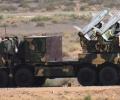
India's defence sector is on the cusp of a 'super cycle' of growth, driven by escalating geopolitical conflicts and a strong policy push towards indigenous manufacturing, with major players like BEL, HAL, and BDL poised for significant order inflows and technological advancements.

'The next phase of India's IPO cycle will be defined by quality, pricing discipline and investor selectivity.'

Aviation Turbine Fuel (ATF) prices have more than doubled to a record high, impacting airlines and consumers, while commercial LPG rates also see a significant increase.

India's new manufacturing project announcements more than halved in the fourth quarter of FY26, falling 60 per cent sequentially and 78 per cent year-on-year to approximately 1.7 trillion, driven by global uncertainties, geopolitical conflicts in West Asia, and existing unutilised manufacturing capacity.

The rupee plunged to a fresh low of 93.72 against the dollar on Friday, falling 1.15 per cent in a single session - its sharpest one-day decline since February 24, 2022 - as elevated crude oil prices and strong dollar demand from oil-marketing companies and foreign portfolio investors (FPIs) weighed on the currency.

US Vice President JD Vance leads a delegation to Islamabad for talks with Iran, expressing optimism while warning against bad faith negotiations from Tehran.

The Los Angeles Knight Riders on Thursday unveiled the Knight Riders Cricket Field at Fairplex in Pomona, California, which is set to serve as their base for the upcoming season of Major League Cricket in the United States.

A Deloitte report reveals that Indian enterprises are leading the world in large-scale AI adoption, but are facing a significant skills gap in AI expertise.

Macroeconomic data announcements, global trends and trading activity of foreign investors would be major driving factors for market movement this week, analysts said. Unabated capital infusion by domestic institutional investors have supported the positive trend in the stock market last week, traders said.

Elevated global crude oil and natural gas prices, driven by geopolitical developments in West Asia, could significantly influence the Government of India's fiscal position for 2026-27, according to a report by ratings agency Icra.

Lenders are actively monitoring gold price volatility, prompting them to ask borrowers for additional gold collateral or partial principal repayment when loan-to-value (LTV) thresholds are breached, particularly for loans disbursed in February.

Gurugram police have arrested a wanted accused linked to several ATM thefts amounting to lakhs of rupees. The accused, Aashiq, is a proclaimed offender and has multiple cases registered against him.

'We have lost 70-80 per cent of our business from foreign guests.'

Gold prices experienced a significant drop in futures trading due to global selloff, inflation concerns, and a strong US dollar. Analysts predict a continued downward trend amid geopolitical tensions and potential rate hikes.

Suzuki Motorcycle India Ltd (SMIPL) has revised its domestic two-wheeler sales growth estimate for FY27 downwards from 7-8 per cent, citing rising commodity costs due to the ongoing West Asia conflict and its impact on consumer affordability.
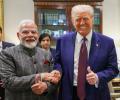
The agreement addresses non-tariff barriers and promotes increased trade in technology products and cooperation between the two countries.

The OECD projects India's GDP to grow at 7.6% in the current fiscal year and 6.1% in 2026-27, despite global economic challenges stemming from the Middle East conflict and energy price volatility.

Indian equities declined on Friday, with the benchmark Nifty posting its worst weekly fall since September, as foreign investor sentiment remained weak amid tepid earnings growth and little progress on the India-US trade front.
Foreign investors have withdrawn over Rs 88,000 crore from Indian equities this month, driven by geopolitical tensions, a weak rupee, and concerns about rising crude oil prices.

In an event-heavy week ahead, stock markets are expected to track Q3 corporate earnings from several blue-chip firms, including TCS and Infosys, while inflation data and global trends would also dictate investors' sentiment, analysts said.
Wipro, India's fourth-largest IT services company, has secured an eight-year deal with Singapore-based Olam group, valued at over $1 billion, and will also acquire Olam's IT and digital services arm, Mindsprint, for $375 million, marking one of its largest contracts to date.

Investors have often been left scratching their heads over why a company's stock fails to move despite delivering beating earnings results, only to see the stock fall. According to theory, beating earnings should translate to higher stock prices, but in today's interconnected world, stock prices do not depend on the numbers.

As the negotiations continued, the Iranian government said on social media that "talks between Iran and the US in Islamabad entered the expert-level stage as economic, military, legal, and nuclear committees joined in".

Escalating geopolitical tensions in West Asia are prompting investors with exposure to Dubai's real estate market to reassess their portfolios. And, in this rejig, India is emerging as a stable destination for capital investment and long-term growth.

Only 2.5 per cent of the equity in Jio Platforms will be offloaded through the OFS route -- meant for secondary share sale.

Gold and silver prices experienced a significant drop in the national capital due to a global selloff driven by inflation concerns, central bank policies, and geopolitical tensions.

Former South African captain Graeme Smith discusses the Indian Premier League's impact on global cricket, highlighting its role in discovering young talents like Vaibhav Sooryavanshi and shaping T20 leagues worldwide.

Direct-to-consumer meat and seafood platform Licious is betting big on "micro markets" within cities as the next lever of growth.

Both sides have now revealed a preference for escalation over strategic defeat, and each new provocation narrows the space for the next pause. The Touska seizure, Iran's refusal to negotiate under blockade, Israel's strikes on Iranian oil infrastructure -- all of these add up to an increasingly untenable situation. This makes the wild card -- Trump and his motormouth -- more consequential than ever, notes Prem Panicker in his must read blog on the Iran War.
 © 2026 Rediff.com - Advertise with us - Disclaimer - Privacy Policy - Sitemap - Feedback - About us - Terms of use - Grievances